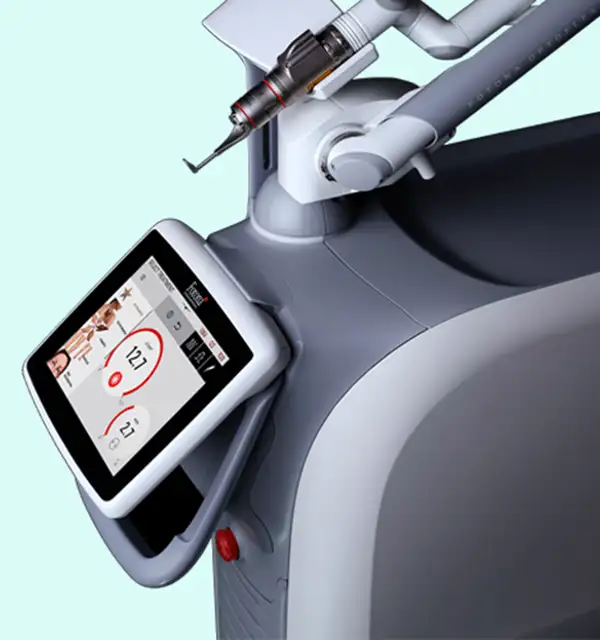
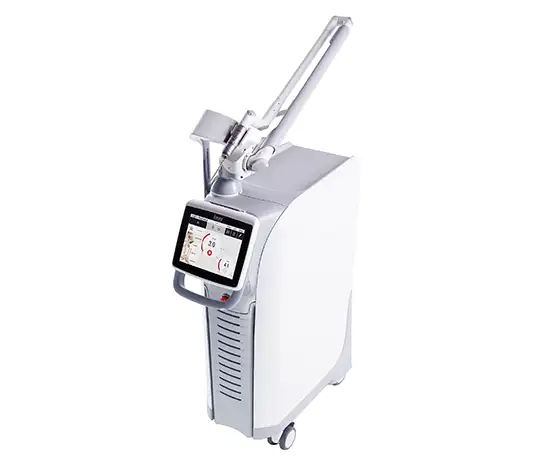
Core Clinical Indications for Fotona StarWalker
Thanks to dual-wavelength versatility and modal flexibility (ranging from MaQX to VERSA3 and FRAC3 modes), StarWalker provides tailored therapeutic protocols:
✦ Advanced Pigmentation Therapy: Clears solar lentigines, age spots, café-au-lait macules, and deep hormonal melasma deposits.
✦ Non-Ablative Skin Rejuvenation: Induces targeted sub-surface micro-injury that stimulates structural collagen deposition, softening fine facial rhytids.
✦ FRAC3® Deep Dermal Tightening: Creates three-dimensional, self-induced micro-islands of thermal coagulation to restore cutaneous turgor and facial elasticity.
✦ Active Acne & Sebum Regulation: Targets propionibacterium acnes thermally while shrinking dilated follicular ostia to stabilize excessive oil flow.
✦ Laser Toning & Fine Hair Bleaching: Disperses melanin in fine facial vellus hair while evening out underlying skin tone.
Platform Advantages & Adaptive Structured Pulse (ASP)
Conventional single-pulse Q-switched lasers often rely on high photothermal heat, which can increase the risk of rebound hyperpigmentation in reactive skin types.
The StarWalker platform circumvents this via ASP technology, shaping pulses to produce mechanical photoacoustic pressure waves. These shockwaves break down dense pigment clusters into microscopic fragments that are cleared by macrophage phagocytosis, preserving neighboring cells.
✦ Dual-Wavelength Precision: Employs 1064 nm Nd:YAG for deep dermal lesions and darker phototypes, alongside 532 nm KTP for superficial epidermal spots.
✦ Homogeneous Flat-Top Beam: Eliminates dangerous hot-spots within the laser spot profile, distributing energy evenly to avoid epidermal burns or tissue blistering.
✦ Versatile Multi-Modal Delivery: Adjusts seamlessly between ultra-short acoustic pulses for pigment shattering and sub-millisecond pulses for tightening.
The Clinical Treatment Protocol
At our Istanbul clinic, each Fotona StarWalker treatment follows a structured medical framework:
✦ Diagnostic Mapping: Quantitative evaluation of pigment depth and vascularity to determine specific wavelength, fluences, and spot dimensions.
✦ Cutaneous Preparation: Thorough clinical cleansing to remove surface lipids; topical anesthesia is applied for specific deep indications if indicated.
✦ Calibrated Laser Delivery: Laser passes are delivered across targeted zones alongside continuous air cooling to soothe the epidermis.
✦ Immediate Post-Care: Mild transient erythema typically settles within 1 to 3 hours; broad-spectrum physical sunscreen (SPF 50+) is applied immediately.
Frequently Asked Questions About Fotona StarWalker
✦ Is the Fotona StarWalker procedure painful?
Most patients feel only a light rubber-band snap or mild prickling accompanied by a rhythmic acoustic tapping sound. Treatment discomfort is low and well tolerated without general anesthesia.
✦ How many sessions are typically required for pigmentation?
Superficial sun spots often clear in 2 to 3 sessions, whereas deeper, chronic melasma or dermal pigmentation requires a structured protocol of 4 to 6 sessions spaced 3 to 4 weeks apart.
✦ Is there recovery downtime after treatment?
Downtime is minimal. Patients experience temporary mild redness lasting a few hours. Because the epidermal layer remains non-ablated, standard social routines can be resumed immediately.