Ptosis Classification & Surgical Management
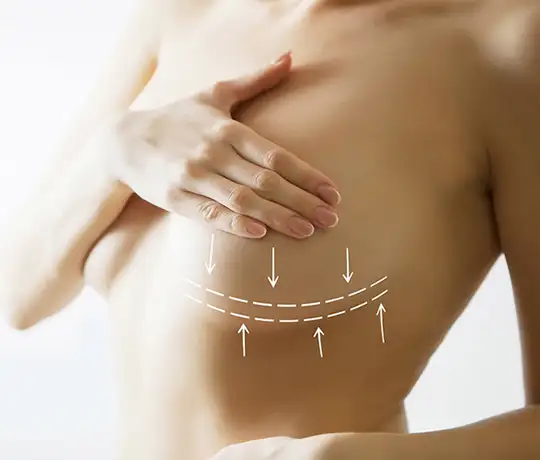
The surgical approach is tailored directly to the degree of breast ptosis and the volume of native glandular tissue:
✦ Mild (1st Degree) Ptosis: When the nipple sits at the level of the inframammary fold without excessive skin abundance, elevation can be achieved solely by placing a cohesive silicone implant (augmentation mastopexy) to fill the upper pole.
✦ Moderate to Severe (2nd & 3rd Degree) Ptosis: When the nipple-areola complex falls below the under-breast crease, redundant skin is excised, and glandular tissue is reshaped into an internal "auto-prosthesis," often combined with a silicone implant for optimal upper-pole fullness.
Pre-Operative Care Framework and Systemic Requirements
Adhering to careful pre-surgical preparation guarantees safe anesthesia management and uncomplicated tissue healing:
✦ Nicotine Restriction: Smoking and all tobacco products must be stopped 3 weeks before and 2 weeks after surgery to preserve microvascular blood flow to the wound margins.
✦ Medication Protocol: Blood thinners, aspirin, NSAIDs, and herbal supplements must be paused under medical guidance 10 days prior to surgery.
✦ Diagnostic Screening: Patients under 40 undergo high-resolution breast ultrasound, while patients over 40 complete a routine mammogram screening before surgery.
Postoperative Recovery Protocol and Timeline
Following vertical tissue repositioning, post-operative recovery follows structured healing phases:
✦ Medical Compression Bra: A specialized supportive medical bra is worn continuously for 3 to 4 weeks to stabilize elevated tissue and reduce tissue tension.
✦ Social and Work Return: Most patients return to desk professions and light daily routines within 7 to 10 days.
✦ Physical Activity: Light cardiovascular walking can begin after day 7, while heavy upper-body lifting and intense workouts must be suspended for 6 weeks.
Frequently Asked Questions About Breast Lift Surgery
✦ Where are the incisions placed during a breast lift?
Depending on the degree of sagging, incisions are placed around the areola (circumareolar), vertically down to the crease (lollipop), or along the inframammary fold (Inverted-T anchor), fading into pale, thin lines over 12 months.
✦ Should I get a breast lift alone or combine it with an implant?
If your breasts have lost significant glandular volume leaving the upper pole hollow, combining a lift with a cohesive silicone implant restores both youthful elevation and décolleté fullness.
✦ Can non-surgical treatments or exercise lift sagging breasts?
No. Sagging represents structural elongation of skin and Cooper's ligaments. Exercises strengthen pectoral muscles beneath the breast but cannot shrink excess skin or lift dropped glandular parenchyma.
✦ Will a breast lift affect my ability to breastfeed, and how long is the recovery?
Central parenchymal and ductal connections to the nipple are meticulously preserved during surgery to safeguard lactation potential. Patients stay 1 night in the hospital and resume desk work within 7 to 10 days.