What Is the Clinical Recovery Timeline and Downtime for K-Lift Max?
Following deep plane tissue manipulation and rigid anchoring, experiencing a localized sensation of fullness, moderate tension, and mild pressure across the temporal pockets for the first 2 to 3 days is a typical component of the biological healing response.
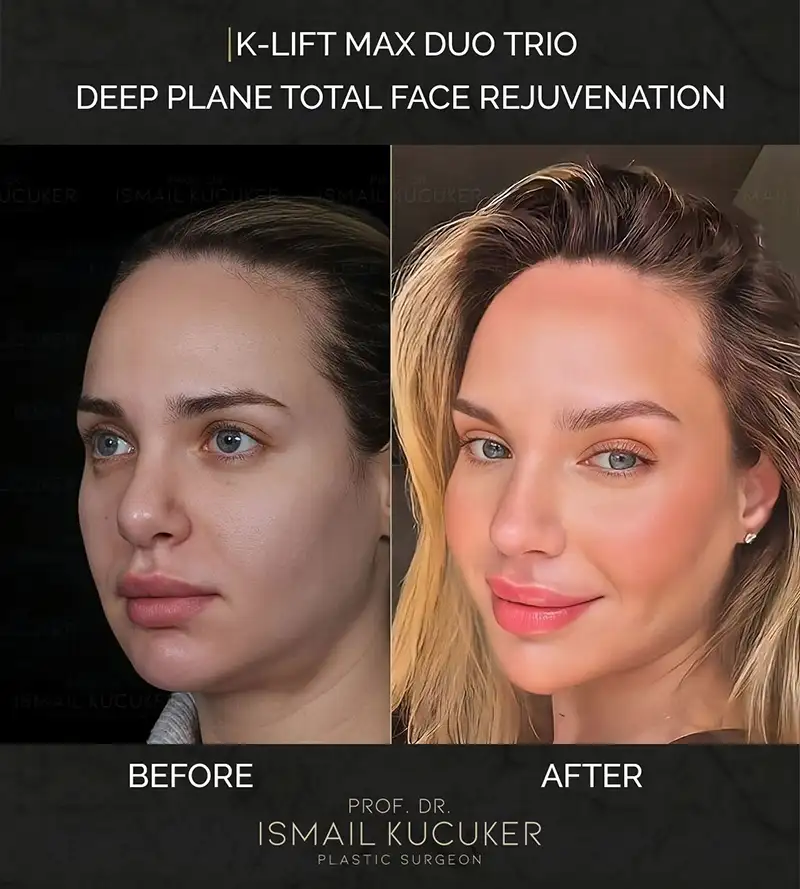
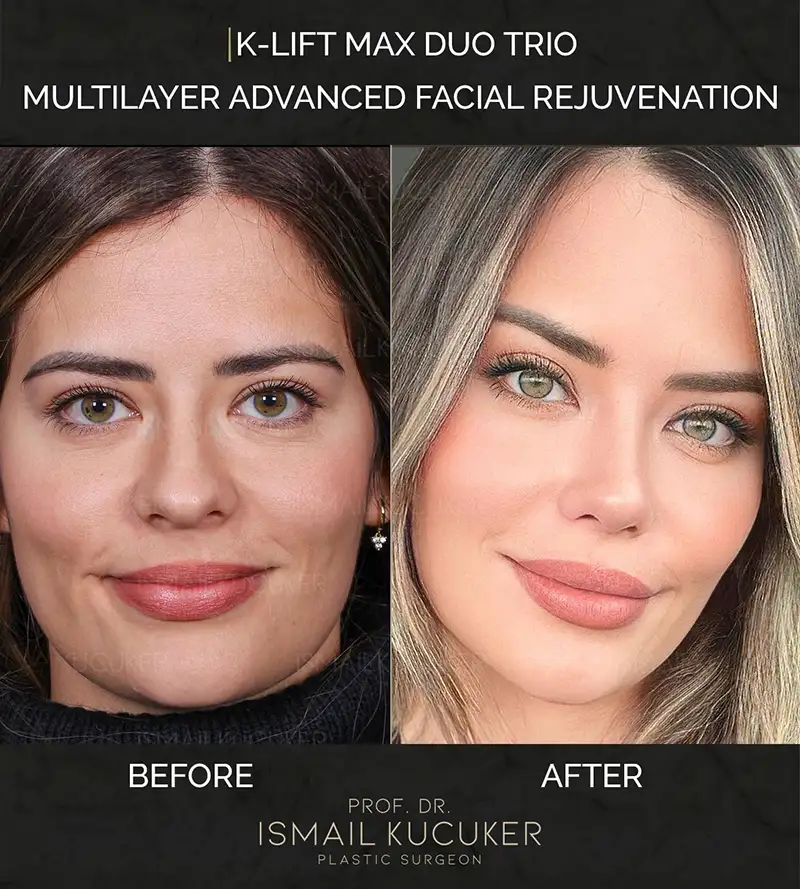
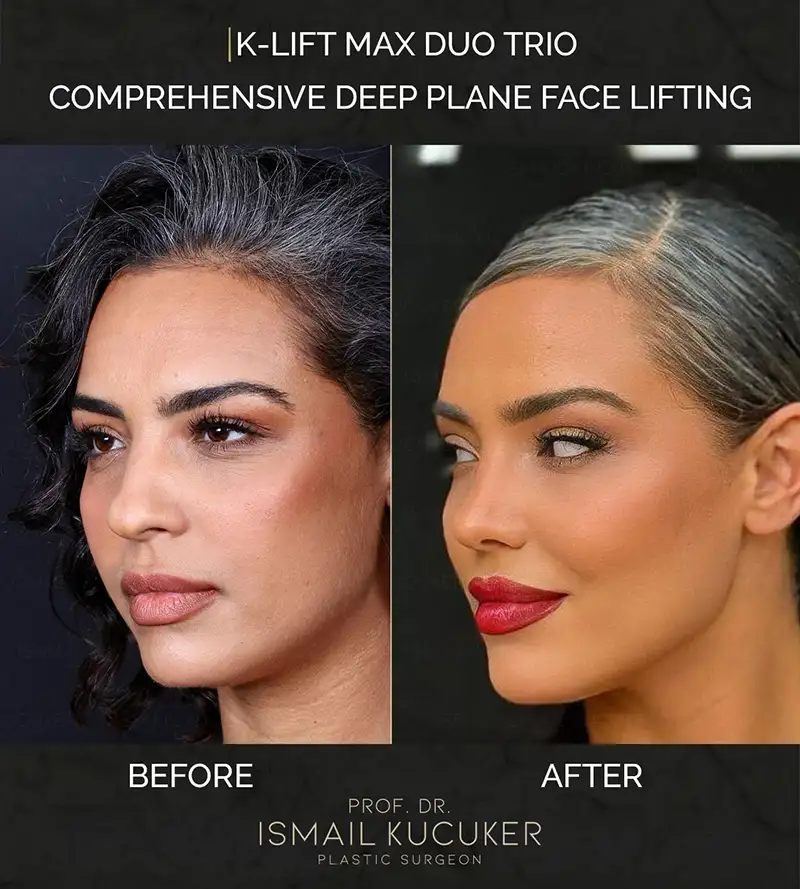
Aesthetically, patients will display a deliberate "overcorrected" or hyper-elevated appearance during early recovery. Over the healing cycle, natural soft tissue relaxation softens approximately 50% of the initial surgical tension, guiding the facial features into their perfect, natural anatomical position.
✦ Week 1 Post-Op: Post-surgical edema peaks; the hyper-correction and slanting vector sits at roughly 90%.
✦ Week 2 Post-Op: Social and professional routines are resumed; the apparent overcorrection reduces to approximately 70%.
✦ Week 3 Post-Op: Deep tissue integration accelerates as localized tension sensations settle to around 50%.
✦ Month 1 Post-Op: Deep plane suture fixation stabilizes completely; apparent overcorrection settles near 40%.
✦ Weeks 6–8 Post-Op: Residual overcorrection tapers down to 10–25%, revealing elegant, defined facial contours.
✦ Months 3–4 (Final Outcome): Structural remodeling concludes, subcutaneous micro-edema fully clears, and the soft, natural rejuvenation profile settles permanently.
"Based on extensive clinical data, the absolute gold standard for comprehensive facial restoration is a concurrent surgical combination: Structural Rhinoplasty, the K-Lift Max deep plane lifting technique, and micro-structural autologous Fat Grafting performed within a single session."
Frequently Asked Questions About K-Lift Max Surgery
✦ How is K-Lift Max different from traditional facelift or thread lifts?
Unlike thread lifts that offer temporary support or traditional facelifts that pull superficial skin, K-Lift Max releases and repositions deep anatomical retaining ligaments and the SMAS plane, delivering natural, permanent rejuvenation without tension lines.
✦ Where are the incisions placed in K-Lift Max Duo and Trio?
Micro-incisions are concealed within the temporal hairline and natural anatomical contours, making scars undetectable after healing.
✦ Why is surgical hyper-correction necessary during the procedure?
Deep plane lifting accounts for post-operative tissue relaxation and gravitational force. Initial overcorrection ensures that as tissues settle over 3 to 4 months, the final result achieves ideal anatomical harmony.
✦ What is the anesthesia type, stay duration, and recovery time for K-Lift Max?
K-Lift Max is comfortably performed under local anesthesia with sedation. Patients are discharged on the same day without an overnight hospital stay, returning to desk work and social routines within 7 to 10 days.