Surgical Methodology and Operating Room Management
Reduction mastopexy is conducted entirely under general anesthesia, requiring an average operating time of **2.5 hours**. To assist families awaiting the patient, an additional 1.5 hours must be factored into the overall timeline to account for pre-surgical markings, anesthesia induction, and post-op recovery in the PACU.
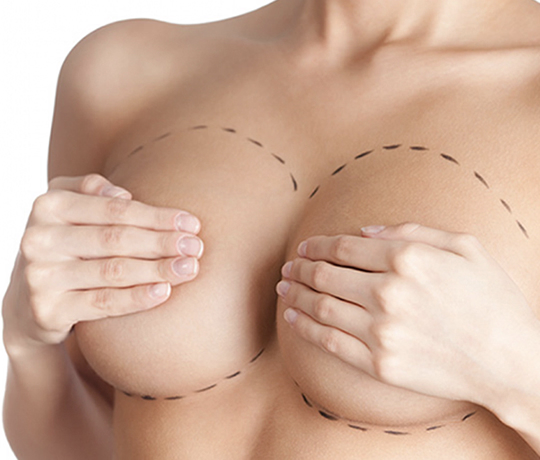
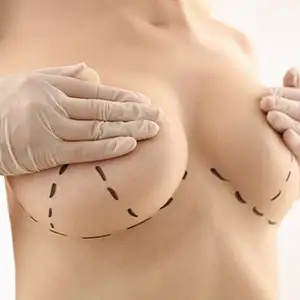
During the procedure, the drooping nipple-areola complex is carefully isolated on a living tissue pedicle (preserving its deep blood vessels and nerve pathways) and moved upward to its youthful position. Excess underlying breast gland, fat, and skin are resected, and the remaining tissue is shaped into a tight, konik (conical) form. Depending on skin abundance, the dikiş hatları (suture lines) are mapped using either a vertikal (vertical/lollipop) incision or an **Inverted-T (Ters T)** scar architecture.
Breast Reduction Frequently Asked Questions (FAQ)
Will my breasts be perfectly identical after surgery?
Because the two halves of the human framework are naturally asymmetrical—with variances in rib cage projection, shoulder drop, and chest wall alignment—achieving flawless mathematical symmetry is extremely rare. Minor post-operative variations in nipple projection, areola diameter, or breast shape are entirely normal biological realities. The goal is to establish optimal harmony and balanced body proportions.
How painful is the procedure, and what is the hospital stay?
Contrary to widespread misconceptions, breast reduction is remarkably low in post-operative pain. Patients experience a mild, dull pressure or tight sensation when moving their arms, which is easily managed with simple oral painkillers for the first 24 to 48 hours. Patients stay in the hospital for 1 night, and are comfortably discharged the following morning once the temporary submammary drainage lines (drenler) are removed.
What kind of scars are left, and how can I minimize them?
Surgical entry requires a permanent disruption of the skin layer, meaning scars are an absolute biological certainty. Cilt (skin) heals through the production of cellular scar tissue, the quality and width of which are determined almost exclusively by your personal genetic code rather than dikiş tekniği (suturing technique). To minimize scar tracking, patients must adhere to the following protocol:
✦ Strict Nicotine Cessation: Avoid all smoking and tütün (tobacco) products for 3 weeks pre-op and at least 2 weeks post-op to protect microvascular blood flow to the wound edges.
✦ Silicone Gels and Hydration: Apply specialized medical scar-reduction creams twice daily for three consecutive months, starting on post-operative day 15.
✦ UV Sun Shielding: Keep healing incision lines completely shielded from direct sunlight or tanning beds for three months to prevent permanent dark hyperpigmentation. Custom silicone sheets can be integrated for select skin types.
Can I breastfeed my baby after reduction mastopexy?
Cerrahi techniques at our clinic actively preserve the functional upper and medial parankim segments of the breast, maintaining their vital attachments to the nipple-areola complex. Therefore, there is no structural reason preventing post-op breastfeeding, and we fully support it. However, it is important to note that many women with unoperated macromastia naturally possess reduced milk-yielding capacity due to dense fatty tissue; since milk production lacks a absolute medical guarantee even in unoperated breasts, no surgical outcome can promise absolute breastfeeding success. If you plan a pregnancy soon, this must be discussed pre-operatively.
Will I experience permanent loss of sensation in my nipples?
Nipple sensation is supplied by deep intercostal nerve branches entering from the outer lateral breast wall in 90-95% of women, and from medial paths in 5-10%. Because microscopic nerve pathways cannot be mapped before an incision, 5-10% of patients may experience temporary early numbness or uyuşukluk. However, as the local tissue networks regenerate, normal sensation returns in almost all patients by the end of the first year. The statistical risk for permanent, complete loss of sensation stands at less than 1%.
What is the post-operative recovery timeline and activity matrix?
✦ Early Healing and Bathing: Soluble intradermal aesthetic dikişler are utilized, removing the need for stressful stitch extraction. Thin surgical tapes protect the lines, and patients can safely take a warm bath by day 8 following their secondary dressing.
✦ Surgical Bra Management: Wearing the specialized elastic kompresyon/sports bra continuously for 3 full weeks is mandatory to support the newly coned breast weight and reduce deep edema.
✦ Professional and Travel Return: Patients can comfortably return to desk professions and travel after **10 days**, provided long-distance driving is avoided for 2 weeks. Local edema resolves by week 3, while full structural setting and scar softening require a 1-year maturation cycle, supported by follow-up clinical checks and ultrasounds at months 6 and 12.
✦ Fitness Restrictions: Light walking can be safely resumed on day 10. Strenuous sports, weightlifting, tennis, or intensive cardio workouts must be strictly suspended for 3 months to protect internal healing planes.
What happens if I experience massive weight fluctuations or pregnancy later?
Extreme systemic weight gain, future pregnancies, or intense breastfeeding can cause the remaining adipose tissue to expand and stretch the skin envelope again, potentially leading to secondary sagging due to gravity. Should this occur, a secondary revision mastopexy can be safely performed, provided the patient’s prior surgical records and technical details are shared with the surgeon. Patients presenting with keloid conditions should strictly avoid this surgery, as pathologically raised scars can compromise overall procedural satisfaction.
Pre-Operative Preparation Framework
To ensure a smooth, complication-free procedure, your surgery should be scheduled outside your active menstrual cycle to minimize tissue vascularity and breast swelling. Patients must stop taking aspirin, anticoagulants, or NSAIDs 10 days prior, and alcohol must be suspended for 48 hours. Any acute illness—such as a cold, flu, or sore throat—must be reported to the clinic immediately. Finally, to comply with anesthesia requirements, a strict fast (no water or food) is mandatory after 24:00 midnight before your surgery.