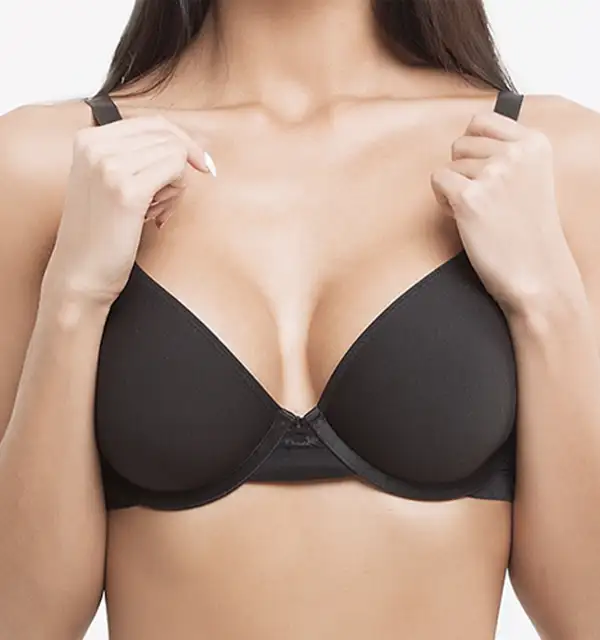
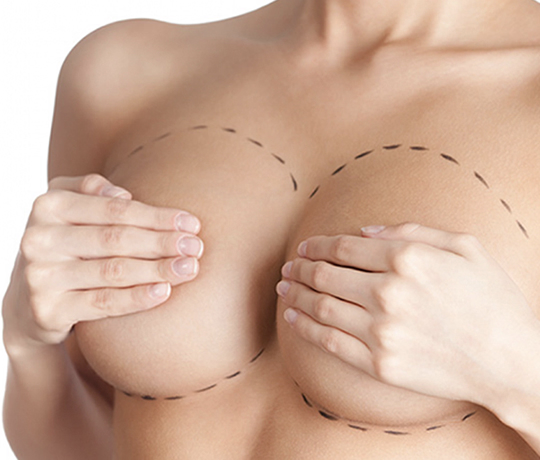
Anatomical Planes: Submuscular (Kas Altı) vs. Subglandular (Kas Üstü) Placement
The choice between placing the breast implant above or below the pectoralis major muscle is not a matter of one technique being universally superior; rather, it depends entirely on the patient's individual tissue thickness. If the upper breast tissue measures over 2 cm during a clinical pinch test, the **Subglandular (Kas Üstü)** or subfascial plane is highly effective; it involves significantly less post-operative discomfort, ensures a rapid return to work, and avoids animation deformity during high-impact sports.
Conversely, for zayıf (thin) or athletic patients with sparse tissue coverage, the **Submuscular / Dual-Plane (Kas Altı)** approach is the gold standard. Placing the upper portion of the implant beneath the muscle protects against long-term palpability, prevents edge visibility, and drastically reduces the incidence of soft-tissue rippling. While submuscular manipulation entails a slightly higher initial recovery curve and transient muscle-contraction awareness during heavy exercise, its capacity to safeguard long-term results in thin-skinned candidates is exceptional. Both planes deliver equal excellence in terms of ultimate visual naturalness when aligned with the correct tissue profile.
Understanding Operating Room Timelines and Anesthesia Care
A primary isolated implant placement takes an average of 1 hour, whereas a composite breast lift-augmentation demands roughly 2 hours of highly detailed surgical work. For family members awaiting the patient, the total duration within the surgical suite will include an additional 1.5 hours of non-surgical preparation and recovery phases:
✦ Pre-Surgical Induction Phase: Patients enter the surgical theater roughly 30 minutes before the actual incision to undergo sterile field charting, compression stocking application, and intravenous anesthesia mapping in the pre-op suite.
✦ Post-Anesthesia Recovery (PACU): Following wound closure, patients spend 30 to 45 minutes resting in the specialized recovery lounge under direct monitoring as general anesthesia safely clears the systemic circulation.
✦ Strict Pre-Op Fasting Rules: To secure absolute airway protection during intubation, patients must remain strictly NPO (nothing by mouth)—including clear liquids or water—past 24:00 midnight prior to the scheduled surgery.
Breast Augmentation Frequently Asked Questions (FAQ)
Will my breasts remain permanently upright and perky after surgery?
In patients presenting with highly elastic skin who have not undergone substantial post-partum stretching, an implant maintains pristine upper-pole perkiness for a long duration. However, for patients exhibiting advanced tissue changes due to pregnancy or massive weight cycles, the natural dermal kılıf (skin envelope) remains biologically prone to stretching. Even when surgically tightened, gravity and tissue aging can cause gradual changes over time; approximately one-third of these complex cases may benefit from a minor skin-tightening refinement under local anesthesia years later.
Can I select absolutely any implant size that I desire?
The clinical answer is no. Every individual profile possesses a specific anatomical threshold governed by chest wall width, inter-mammary distance, and soft-tissue laxity. Forcing an oversized implant into a restrictive pocket disrupts local blood flow, causes visible striae (skin stretch marks), increases the risk of dikiş açılması (wound dehiscence), and compromises long-term tissue support. Trusting your surgeon’s golden-ratio dimensional choices guarantees a lifetime of elegant stability.
Do silicone implants cause cancer, and do they block mammograms?
Extensive global research by institutions like the FDA confirms that silicone implants carry absolutely no link to classical breast cancer (adenocarcinoma). Implants are structurally isolated by a protective tissue capsule formed naturally by your body, ensuring no direct contact with the mammary glands.
While an exceedingly rare lymphoproliferative condition named BIA-ALCL (occurring in roughly 1 in 30,000 textured cases) has been identified in late stages via localized seroma fluid swelling, it is completely resolved in 95-97% of cases by simply removing the implant and its capsule. Furthermore, implants do **not** prevent mammography; by pushing native breast tissue forward, they can actually make manual self-examinations more accurate. Experienced radiologists easily utilize modified Eklund displacement views to secure flawless diagnostic tracking.
What are the true differences between round and anatomical (teardrop) implants?
The ideal shape profile depends entirely on your natural breast tissue base and dekolte (décolleté) goals:
✦ Anatomical (Teardrop) Implants: Feature a sloping profile that mimics natural anatomy, concentrating volume across the lower pole. This is ideal for thin patients with minimal native tissue who prioritize a classic, subtle transition.
✦ Round Implants: Possess a symmetrical dome shape with a central apex. This is highly recommended for treating post-pregnancy upper-pole deflation, delivering a distinct push-up effect and full décolletage curve.
What is the exact post-operative recovery timeline and return-to-work matrix?
✦ Hospitalization and Early Days: Patients routinely stay in the hospital for 1 night and are comfortably discharged the following morning after temporary drainage lines are removed. Sensation adjustments or mild localized swelling around the nipple are completely normal and clear spontaneously. Soluble intradermal dikişler (stitches) are utilized, removing the need for suture extraction.
✦ Surgical Bra Requirements: Wearing the specialized post-operative stabilization compression bra continuously for 3 weeks is mandatory to secure the implants in their designated anatomical beds. Following this phase, standard underwear choices can be resumed.
✦ Social Resumption and Fitness: Subglandular implant patients can return to desk professions by day 5, while submuscular placements require roughly 10 days. Light walks are encouraged by day 10, and brief swimming is permitted after 1 week once dressings clear. Heavy gym eforts, tennis, or upper-body weightlifting must be strictly suspended for 3 to 4 months.
Will my breasts look and feel perfectly identical? Can satisfaction be guaranteed?
Because the human body is inherently asymmetrical—with variations in chest wall bone curvature, rib cage projection, and muscle strength between the dominant and non-dominant sides—achieving absolute mathematical symmetry is extremely rare. Minor variances in nipple tracking or volume are perfectly natural.
Furthermore, because tissue healing involves complex biological reactions unique to each individual, medical science cannot offer a contract of guaranteed satisfaction. Minor scar remodeling or capsular contractions can occur across any global series, which is why a transparent partnership between patient and surgeon represents the ultimate foundation for a successful, beautiful transformation.
Advanced Post-Surgical Scar Minimization Protocol
✦ Strict Smoking Cessation: Avoid all nicotine and tobacco use for at least 3 weeks post-op to ensure optimal microvascular blood flow to the incision edges.
✦ Targeted Hydration and Creams: Maintaining constant hydration along the incision lines using advanced silicone-based scar gels—applied twice daily for three full months starting on post-op day 15—dramatically minimizes scar thickness.
✦ UV and Solar Shielding: Protect the healing incision regions from direct sunlight, UV exposure, or tanning beds for at least three months to prevent permanent hyperpigmentary darkening of the tissue.